Editor’s Note:
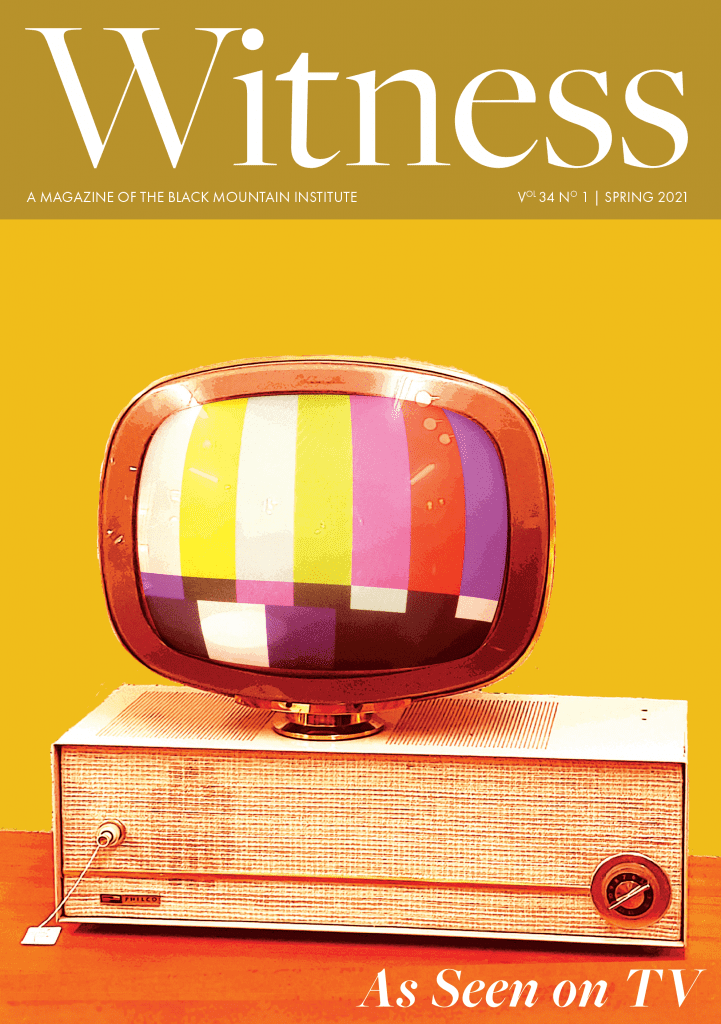
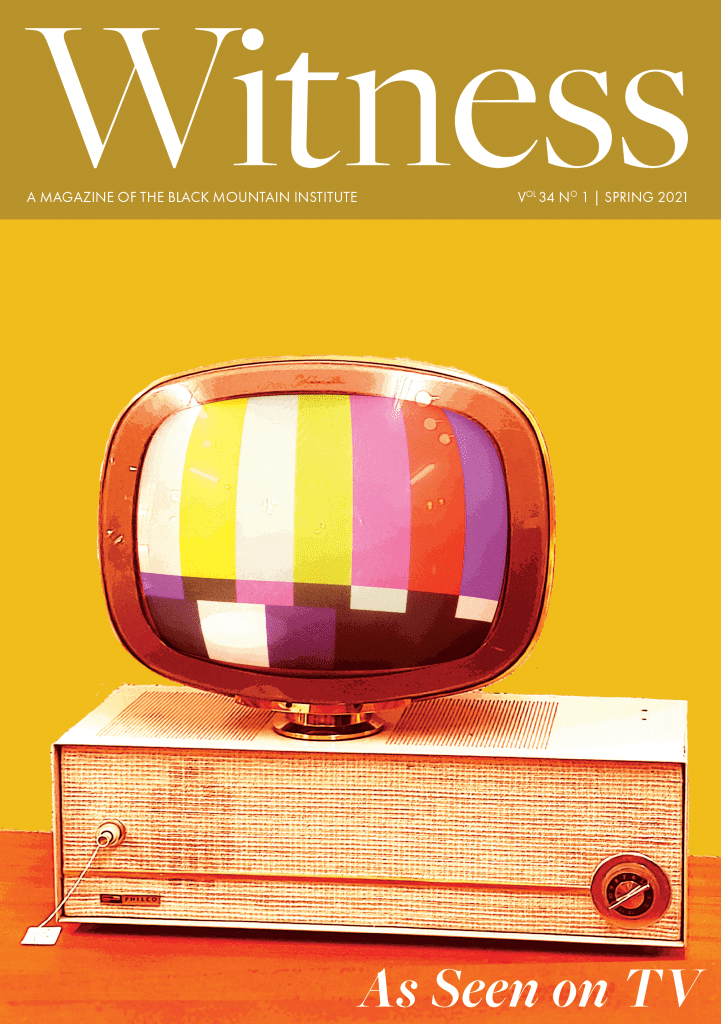
In the year when movie theaters closed, performances were canceled, and human interaction was hard to come by (or impossible to escape), a year of sickness, uncertainty, outrage, anxiety, and unrest, who in possession of a TV didn’t turn it on for a little solace? Witness’s “As Seen on TV” issue asks questions about what draws us to the tube and how we see ourselves and the world through the fantasies flashing on screen. What otherwise unseen or overlooked realities, the pieces gathered here further ask, does TV bring into view? The tagline we take as our title, “As Seen on TV,” is a come-on, a lure of late-night infomercials, a reassurance that the thing you buy will bring the wonders of TV to you. The phrase “As Seen on TV” also has a retro ring to it in an era of streaming and Zoom life, when it’s possible to stare at a screen all day without ever taking a commercial break or stumbling on a public access channel.
The writers in this issue are alternately nostalgic for and disillusioned by TV’s promises. They vividly show how its images and storylines filter into life off-screen, providing imaginative frameworks for and a means to tune into even messier storylines and characters off camera. Whether you channel surf or binge read, whatever your preferred genre, you’ll find an array of TV dreams invented or startlingly re-envisioned here: sci fi, Western, foreign import, breaking news, reality programming, high school drama, yoga, crime, music video, gothic horror, celebrity talk show, political spin, suburban cinéma verité—they’re all included.
We also invite you to join us for some special programming: the winners of our 2021 Witness Literary Awards. Our judges for this third year of the awards were fiction writer Bonnie Chau and poet Sally Wen Mao, both 2020-2021 BMI Shearing Fellows, and essayist and memoirist Cinelle Barnes. We are grateful to these brilliant judges and delighted to share the stellar winning work they selected by Grace Spulak, Shabnam Bozzelli, Samantha Grenrock, Amber Adams, Clancy Tripp, and Keya Mitra.
We hope that, like us, you’ll find in these pages diversion, provocation, some joy, even some comfort, and writing that keeps you tuning in for more.
–E.S.
Literary Awards
Grace Spulak, More Than Bright
Shabnam Bozzelli, The Moving Finger Write
Samantha Grenrock, The Vertical Farm
Amber Adams, Liminal
Clancy Tripp, Smilemakers
Keya Mitra, South on Sisters
Poetry
Lance Larsen, Hospice
Samuel Piccone, Channel Surfing
Maya James, Signs of Rain
Jaydn DeWald, GRID (13)
Irene Cooper, vacuum
Haolun Xu, Rules of Gargantua
Oak Morse, Summer
Collin Callahan, Signal Transfer Malfunction
Jennifer Battisti,
Celia Bland, Shooting Script, Brazen Jackson, Season One, Ep. 1
Hari Alluri, Letter to Galactus Ending On a Variation of a Line by Michael Ondaatje
Fiction
Rob Benvie, Into the Air
Kelsey Peterson, The Mall
Hayden Casey, Hot Yoga
Brett Biebel, Spin it Straight, Spin it True
Brandon French, Columbo
Kathleen Heil, Via Amerigo Vespucci
Linda McMullen, The Twelve Dancing Princes, and Me
Michelle Ross, Paula Watt
Sumita Mukherji, Waiting
Alex Foster, The Core Being Bends to Freedom
Non-Fiction
Cynthia Gralla,
Lydia Paar, Blockbuster
Kevin Wood, Backlit Hollywood
You can find video postings of some of these selections, as read by the authors, on our YouTube channel.
Witness blends the features of a literary and an issue-oriented magazine to highlight the role of the modern writer as witness to his or her times. Launched in Detroit in 1987, the magazine is best known for showcasing work that defines its historical moment; special issues have focused on political oppression, religion, the natural world, crime, aging, civil rights, love, ethnic America, and exile. The issues “New Nature Writing,” “The Sixties,” “Sports in America,” and “The Best of Witness, 1987 – 2004” eventually appeared as university press anthologies. In 2007, Witness moved to Black Mountain Institute at the University of Nevada, Las Vegas. The magazine publishes one print issue and one online issue a year, and increasingly seeks out work that contextualizes the American experience by highlighting issues of global concern.